A Deep Analysis of Metaphor: Refantazio Battle System
A couple of years ago, I wrote a text discussing the resurgence of turn-based combat, especially in RPGs, and how the trend and quality standard of these games were growing in what seemed like a second golden age after the PS1 era. With Baldur’s Gate III winning the 2023 Game of the Year award and Balatro and Metaphor: ReFantazio being nominated for the biggest award, and with much of the community complaining that other prominent examples of this mechanic, like Persona 3 Reload and Like a Dragon: Infinite Wealth, were not included in the category, it seems I was right.
This has led me to want to delve deeper into what mechanics and elements make turn-based RPGs enjoyable and explore the tools available, especially to AAA games, that make these games so engaging. I ventured into various RPGs, and after over 300 hours spent on different titles, I’d like to analyze what might be the game of the year and why I’m not particularly fond of its combat design.
To understand why I don’t like Metaphor’s combat, it’s necessary to look at the agents involved, specifically the concept of enemies. The term “enemy” is quite broad in video games and can be divided into two main categories: regular enemies and bosses. In the last decade, a third, intermediate variant has emerged—minibosses—and, if pushed, even certain environmental obstacles can be seen as “enemies,” but for this analysis, I’ll only focus on regular enemies and bosses.
The purpose of a regular enemy is to present a dichotomy, a decision the player must make. Fighting an enemy comes with a series of advantages: in RPGs, it might mean gaining experience, loot, strengthening your team with new members, or earning attribute points. But there are also disadvantages: losing mana, health, being defeated, using items, etc. Each enemy has a balance that weighs its benefits against its drawbacks, and the player only engages in combat when it tilts in their favor.
This explanation isn’t even limited to turn-based games or RPGs. Metal Gear is a game that presents an unstable balance where taking risks can be very detrimental, but it’s used as an immersive mechanic to make you feel like a spy.
The values assigned to each side of this balance don’t necessarily have to be purely mechanical or tied to exponential growth. For instance, Undertale uses the player’s morality to make them reconsider whether they truly want all those benefits if it means killing a character in the game.
Each game configures its enemies’ decisions in the way that best fits the game’s spirit. For example, fighting an enemy in Dark Souls is usually a bad decision because they are positioned with malice; a combo can defeat you, or a small fight can turn into a duel where you barely survive. Especially when you consider that dying means losing all unsaved progress at a bonfire. However, this is what an unforgiving world demands, where the avatar is an intruder who must prove they are worthy of the throne.
Other titles, and this is where I want to go, make battles so simple that not engaging is the bad decision, as the player would be wasting a virtually free source of resources. In turn-based RPGs, where random and generic encounters are common, this is the approach I think they should take. The game should make the player want (or at least not care) to fight a large number of enemies because it is unilaterally beneficial, even though this isn’t strictly true—I’ll get to that soon.
Persona 3 Reload does this brilliantly. The game features a structure called Tartarus, which is divided into 263 levels that the player must continuously explore throughout the story. On each floor, random enemies appear that the player can either skip or fight. Because of the way the combat system is designed, allowing the player to exploit advantages over enemies as soon as they discover them (which is well done because it’s not competitive and doesn’t have to be balanced), players are motivated to fight. As I said, it would be foolish not to take a battle that only takes a few seconds and has no drawbacks. Because there are no drawbacks, right?
In general, players overthink the intrinsic decisions a game presents unless it makes them obvious, like in Detroit: Become Human, or in competitive contexts at the highest level, such as Counter Strike 2 or League of Legends tournaments. The brain takes shortcuts, and this happens in video games too. This behavior is amplified in large-scale, content-rich genres like RPGs, where the optimal configuration isn’t the norm, and a balance between comfort and utility is favored.
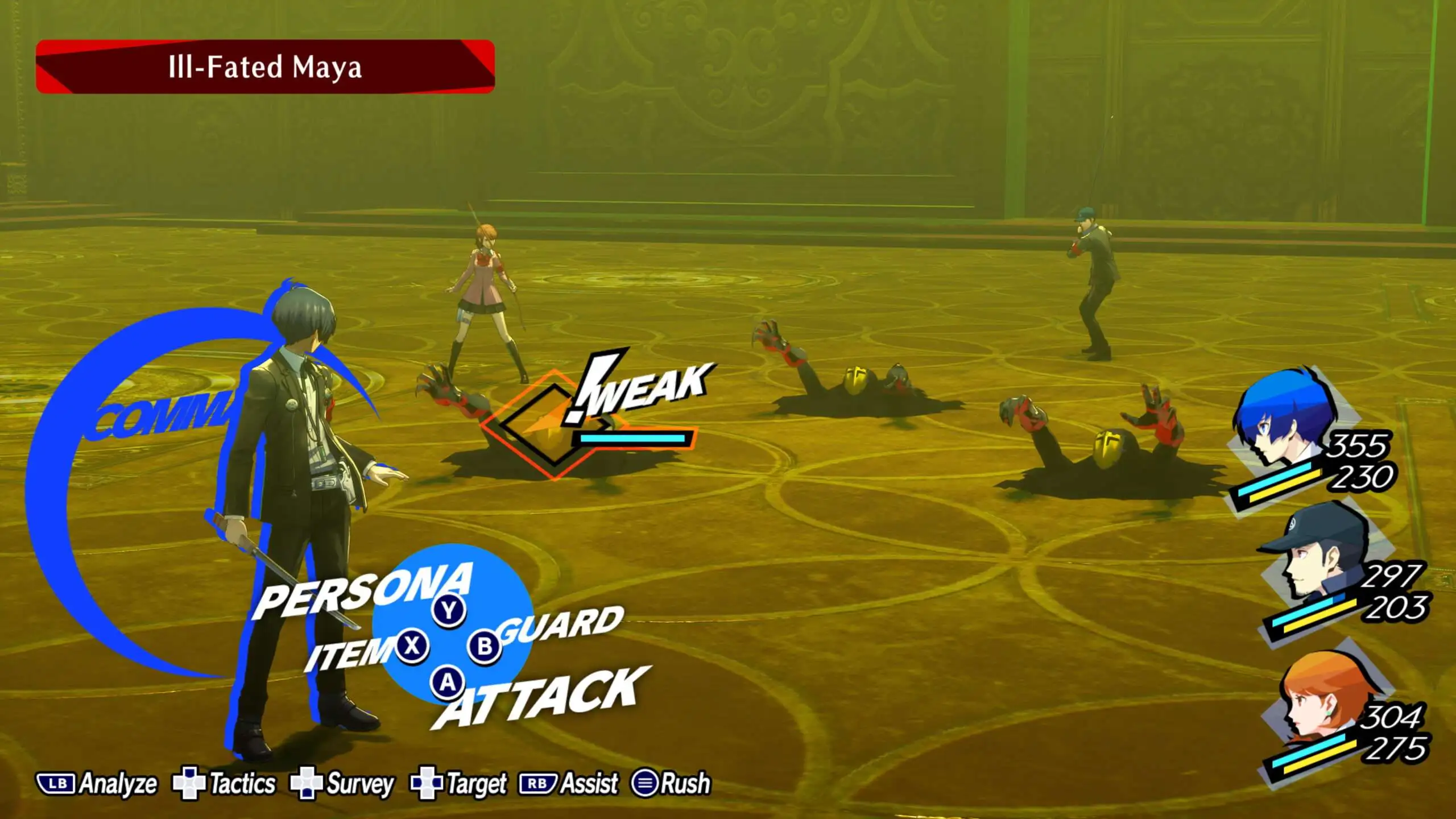 Persona 3 Reload typical encounter
Therefore, when a player doesn’t perceive a significant disadvantage, their brain creates a shortcut that simplifies encounters with regular enemies into a simple equation of “regular enemy = benefit” without further thought. But this is a deception, as defeating any enemy comes with a cost.
When entering a dungeon, a gym, or a new area, there will always be a boss at the end that tests you, along with a series of previous enemies. The role of these enemies is not— or should not—be to present a challenge but to limit the resources available for the boss, the true challenge.
In Persona, continuing with that example, the cost is typically mana to exploit the weakness I mentioned earlier. In reality, in the vast majority of cases, it’s that resource that allows you to summon an attack. Thus, combat after combat, the player loses resources needed for the boss but gains others that, in an ideal state, will provide an advantage.
In other words, regular enemies in Persona 3 Reload are excuses the game puts in front of the player to make them consume resources without even realizing it. Disguised as piñatas, the player only starts to notice their situation when they’ve used up a significant portion of their mana. This is how I think enemies should function in a turn-based RPG.
Their simplicity prevents boredom and makes grinding something the player does voluntarily rather than because they need to face a much stronger enemy. Additionally, it serves as a blocker to prevent the player from breaking progression and presents another decision: “Use resources to keep going and face the boss, or rest and have to retrace your steps?”
Through simple encounters, the player gains experience for their party and themselves while losing some resources, whether health, mana, or both. There’s an exchange before the boss where the player sacrifices resources that put them in an ideal state in favor of a future, potentially better state.
Another very clear example is the Pokémon gym. Unless you talk to the person at the beginning, the first real encounter with the gym leader is against their previous trainers. This way, the player can learn about the type of challenge and guess the types and levels of Pokémon they’ll face when fighting the leader. All of this while gaining experience and money.
However, fighting probably costs you some health or, at best, PP, which can be crucial for the boss fight. Once the trainer is defeated, you face the temptation of laziness. That is, “Are you really going to go back to heal your Pokémon now that the leader is right here? You’ve already defeated all the trainers, solved the puzzle, and only have 20% health left on your main Pokémon. Are you really going to go back?”
Regular enemies should provide and take away at the same time. They should offer benefits in an obvious way to make the combat appealing while subtly depleting the player’s resources so they don’t see the downside of repeatedly fighting the same five enemies. In any well-designed RPG with these characteristics, we should want to keep fighting normal enemies because the game cleverly hides the resources it takes from us.
An example of poor implementation is Persona 4 Golden. With a structure segmented into nine dungeons, each with several floors, it’s common to run out of resources after completing two or three of them. Regular enemies can wipe out the party in one bad turn, have no weaknesses, or be several levels higher if the player hasn’t grinded. Constantly facing enemies that don’t reward effort makes it difficult to argue that these encounters contribute to a better experience.
One could argue that this design makes sense to an extent, as the characters frequently talk about training, and after finishing a dungeon, it changes slightly to include optional bosses. Still, it doesn’t seem like an enjoyable loop to me.
If I have defined regular enemies as a concept that should present decisions to the player, bosses should present a challenge. These roles are not interchangeable, and no regular enemy should be harder to defeat than the simplest boss. At least in this context of turn-based RPGs that I’m discussing.
Turn-based combat emerged as a distinct branch of 80s RPGs where less mechanically skilled players wouldn’t struggle as much with challenges. By separating the attack phases of the enemy and the player, the player can take the time to plan their strategy against the opponent. This is what bosses should leverage.
Throughout my life as a gamer, I have encountered many examples of the “health sponge” concept—a boss with over 20 times the health of my character, resistance to all types, immunity to status effects, and the ability to heal itself, turning an epic battle (usually occurring in the final stages of the story) into a monotonous test of endurance, solved more by time than by skill. This is a bad boss in general but a terrible one for turn-based combat, which is more deliberate.
In my opinion, each boss should present its own unique dynamic that, ideally, fits their personality. A hidden puzzle where the player must arrange the pieces before running out of resources. A sort of intellectual challenge where the player has to figure out what’s going on. This is the advantage that turn-based combat has over other types: the ability to plan. Players need to be forced to plan by presenting a mystery that must be solved in the battle itself.
In Pokémon Red, there’s an example I really like related to this concept. The third gym is an Electric-type, a type that is scarcely seen up to that point in the adventure and has a single weakness. Additionally, most of the creatures available in the previous routes are weak to this type. Here’s the challenge, and it presents the question: How do I defeat it?
The solution turns out to be that there’s a nearby cave full of Pokémon that can defeat this gym. It’s a simple answer, but it encourages exploration, which is the ultimate goal of a Pokémon adventure.
Persona 4 is another game that does this well. Each boss has its own gimmick that makes them unique and which the player must figure out during the fight or risk repeatedly dying. The best example is the shadow of Mitsuo Kubo, where you must understand their movement pattern and when they regenerate in order to exploit the advantage.
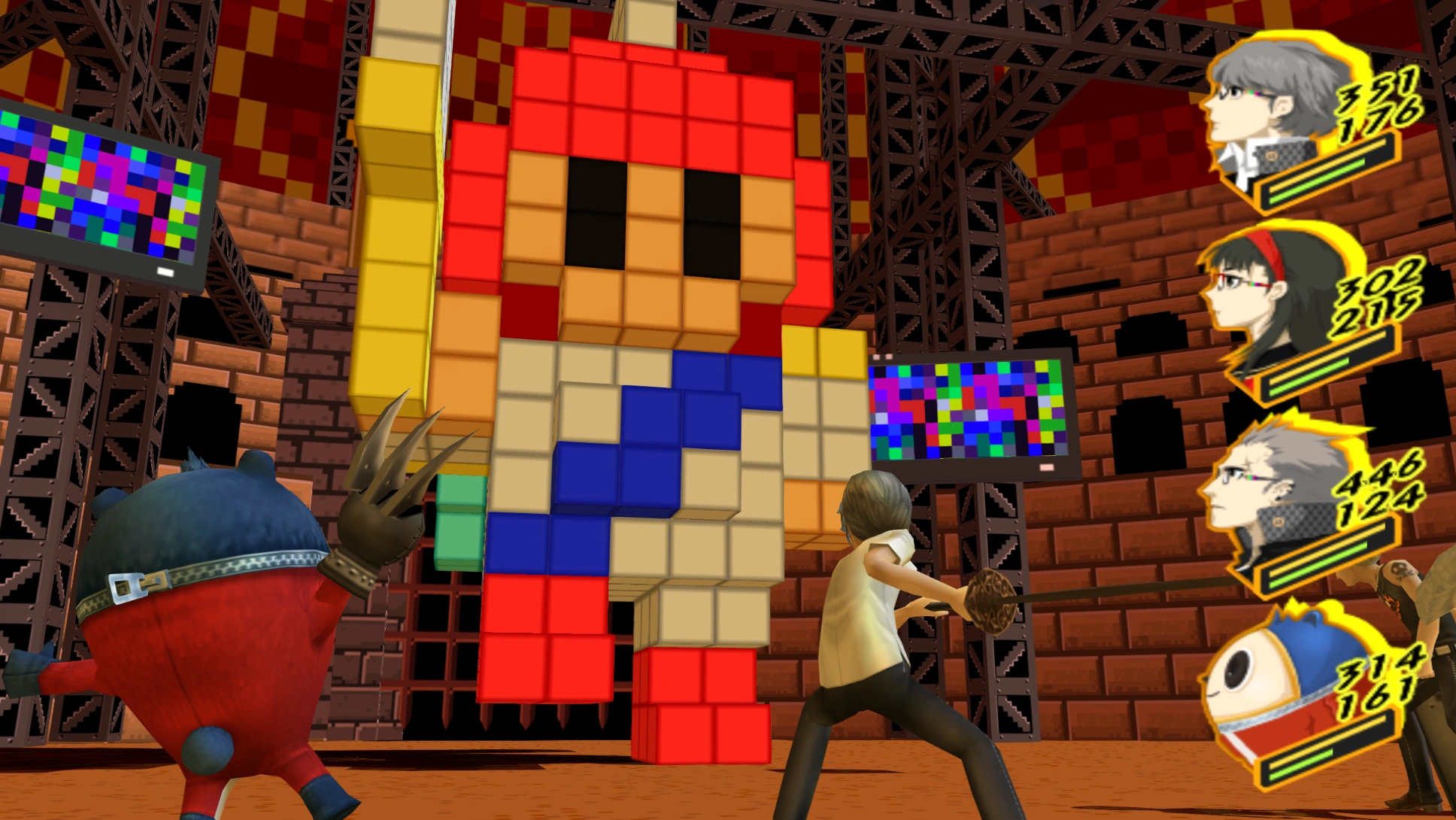 Mitsuo Kubo boss
Interestingly, Persona 3 Reload, which I praised for its handling of regular enemies, has none of this. The problem with its bosses is that, aside from lacking personality and being re-scaled versions of regular enemies, they don’t present the puzzle I mentioned. There’s no mystery, planning phase, or strategy to unravel. They’re just another enemy with more health to appear challenging.
In general, the player has a massive advantage over bosses (and really all battles in the game) because they have a larger party, which allows for more functionality, more items, and prior knowledge gained from regular enemies. This disparity shouldn’t be offset by attacks that one-shot, enemies that are 20 levels higher, moves that literally eliminate the disadvantage of being a single enemy, or by turning them into damage sponges. Instead, it should be addressed by leveraging the strengths of the core mechanic to present a new concept that the player must learn during the battle.
Once we define the roles of the two types of agents that the player must defeat throughout their journey, we need to see what Metaphor: ReFantazio does with them to explain why I consider its approach flawed.
The Game of the Year nominee implemented a new system to create more variety in encounters with regular enemies. Based on the protagonist’s level, enemies are categorized into three color-coded groups: blue if they’re 3 or more levels below the player, yellow if they’re within 2 levels above or below, and red if they’re 3 or more levels above.
Fighting yellow enemies is like a normal combat encounter in any other RPG. They can be more or less difficult depending on the state of the game, the area, and the party’s chosen archetypes. In some cases, they do fulfill the function I described, appearing inherently good to fight because they can be defeated in one turn. Additionally, the game has many underlying mechanics that promote combat: you can steal items from them, and they’re key to unlocking the dungeon boss in several side missions.
In fact, enemies can be stunned outside of combat with real-time attacks, which, when the battle starts, grants each party member an extra turn and takes a third of the enemy’s health. This is a substantial improvement over Persona’s stealth and backstab system, as the player will want to strike as soon as possible to gain this advantage, encouraging the more frantic nature of the game.
However, this real-time combat breaks several fundamental pillars when it comes to the blue enemies. The designers of Metaphor wanted to eliminate trivial battles by allowing players to defeat weaker enemies without entering combat, thus streamlining the gameplay and reducing pauses when entering and exiting battles. The player receives fewer resources (less experience, money, and no chance of obtaining items), but there is no loss involved. Defeating blue enemies only has positive effects on the player. The hidden trade-off disappears.
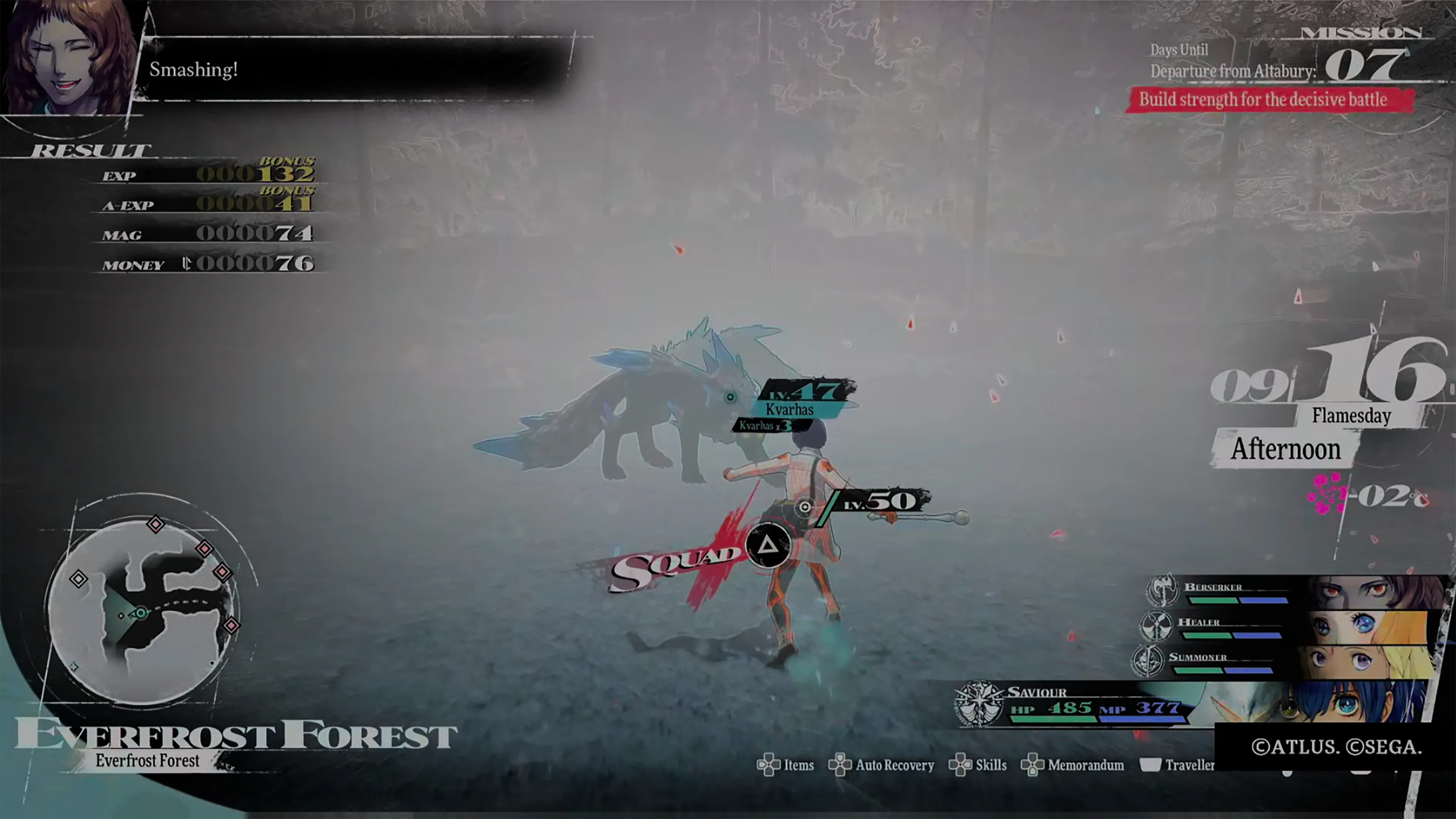 Blue enemies in Metaphor Refantazio.
In response to this, red enemies appear. A sort of miniboss that provides more resources but presents a much tougher challenge than any regular enemy should. They aim to balance out the blue enemies’ contributions, subtracting from them and making the player consume everything that the blue enemies should provide.
It seems like a triangle that balances in theory, but when examined closely, it breaks the flow more than it should lighten it. The player’s impression is that red enemies should be avoided at all costs to avoid losing resources, but this leaves their team perpetually underleveled, leading to a scarcity of blue enemies and creating a cycle that feeds into a negative pattern.
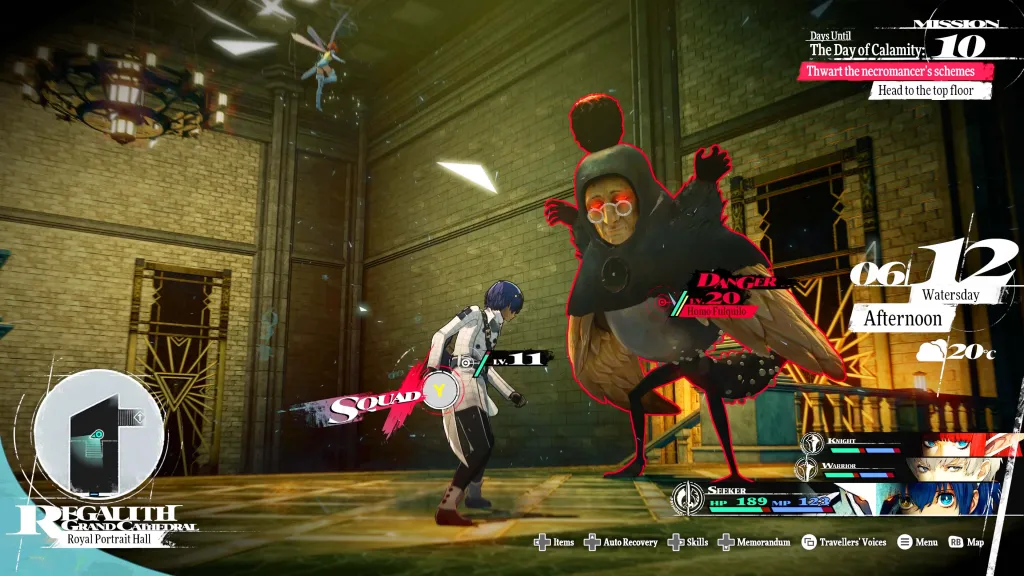 Red enemies in Metaphor Refantazio.
Additionally, in Metaphor, farming is necessary. It is not uncommon to find bosses that are 10 levels higher than the average level of the team. Blue enemies would be perfect for this task because it is tedious, but, as previously mentioned, since they grant less experience, they are not even a viable option for farming.
As can be seen, there is a balance issue within the system of normal enemies that populate the dungeons: blue enemies are useless, contributing neither to the player nor providing meaningful depth for future bosses; red enemies are nonsensical, attempting to counteract the blue enemy’s function, and yellow enemies are the standard, which does not differ from other games.
With this disconnect between the understanding of the player’s mindset and the core combat loop, it is no surprise to find players who avoid all enemies to prepare for the boss (a behavior that is never desired because, then, what is the point of the enemies), players who run out of resources for the boss, or who resort to cheats such as constantly resetting the level or repeating each battle until they adapt to their strategy. Ultimately, it is a system that breaks all the principles I believe should be present in combat of this nature.
On the other hand, there are the bosses. Each mission, whether main or secondary, with a difficulty level higher than one (in a range where the maximum is ten) will have a dungeon with one or more bosses waiting at the end. Before each mission, the game advises the player up to four times to visit a spy who will reveal all the necessary information to defeat the enemy: their weaknesses, strengths, types of attacks, and even patterns the player should pay attention to. This report is accessible at any time, and if it is not obtained, there is usually an NPC in the area who will provide this information.
The role that enemies play in giving hints about the boss battle, reading the environment, and the intrinsic puzzle that a boss should represent in a turn-based fight disappears. The challenge shifts from trying to discover what the enemy hides to overcoming an enemy that attacks the whole party at once, can take more turns than the player, and has a health bar and resistances like that of a “damage sponge.”
The designers of Metaphor are aware that the player will have an initial advantage by having four active members trying to cover as many weaknesses as possible, but they also have the enemy’s attack plan, so they focused the difficulty of the battles on all those aspects that are boring, abusive, or, as they are commonly called, unfair.
The bosses in Refantazio are not bad, but they lack the personality that the title deserves, which feels like a step back considering that it is the same studio that designed the bosses of Persona 4. The models are interchangeable between characters because there are barely any behaviors or attributes that make them distinct, beyond a different affinity list. Some have a special mechanic, such as gaining extra turns under certain battle conditions, but the player might not even notice because they have already been warned about it.
It is due to this new and strange approach to battles that I claim I do not like the decisions the design team has made. I believe they break what, in my view, is the ideal structure of a turn-based RPG, at least currently.
I criticize this point mainly because I know that combat itself is inherited from Shin Megami Tensei and it is unfair to talk about a system that is not its own. However, the system that surrounds combat and its growth is well-conceived.
In Metaphor, there are three elements involved with the team’s abilities and their strength: bonds, attributes, and dungeons. Leveling up or completing each of these consumes a day (from a finite set), but it provides different advantages.
Completing dungeons is the simplest part: defeating enemies and bosses to gain more levels, money, and equipment. Bonds improve the archetypes (summons with abilities), which are also leveled up through time spent in dungeons. Raising bonds means better archetypes, which makes dungeons easier. Finally, attributes are the least important, but several bonds are locked behind a certain attribute value, and completing dungeons increases some of these. This creates an interconnected network between the three mechanics, so improving one brings you closer to improving the others. I think this is a very well-designed system.
Moreover, the moments when each of these elements is prioritized are well-defined. To go to a dungeon, it is common to spend a day traveling on a ship. During this time, bonds can be leveled up, but this is unusual and must match the character’s state with the travel moment. However, attributes can be leveled up. The game reserves travel time to increase the weakest pillar. Thus, the player can use free days to focus on what truly matters: bonds and dungeons, without neglecting attributes.
This is complemented by factors such as time, which make dungeons more difficult to constantly disrupt the player’s patterns and keep their daily routine from becoming monotonous.
The last element to mention is the archetypes. Unlike the Persona series, in which each character has their own Persona (equivalent in function to archetypes) and the protagonist has access to all of them except for those of their companions, in Metaphor, all team members can have the archetypes they wish. There is no role assigned to each character; instead, the player decides how they want to approach the game and what strategy to use for their challenge. On paper, this seems like a good decision, as it gives the player more control. However, as seen with the enemies, there are other mechanics that make this approach contradictory.
Firstly, each character has predetermined stat growth that the player does not control. This significantly limits the range of archetypes they can optimally use. For example, Junah, a magic specialist with low physical resistance, will always be assigned an archetype related to magic attacks, not defense or physical attacks. Additionally, each character has an archetype assigned by the story, which is logically adapted to their level growth, making it pointless to change it except in certain moments.
Again, this contradicts the evolution of the archetypes themselves. To obtain better archetypes within the same branch, the game requires players to meet certain conditions: reaching a specific rank with a character and having another archetype at the necessary level. This forces the player to configure their party members according to the game’s requirements in order to access the best version of their archetype, which conflicts with the idea that each character can take on any role the player desires.
The fact that each character has access to any archetype results in them losing their unique role and reduces their personality in combat, as their function can be replaced by another character. It is odd that the game opted for this full customization approach and simultaneously provided the tools for players to prepare for bosses. If each character had a specific role and the player was aware of what their opponent would do, wouldn’t it be easier to reorganize the team?
Watching gameplay of the game, it becomes apparent that this setup can backfire on the player. Entering an area prepared for a boss where the enemies do not follow the rules that the player anticipated, or having to adapt the team for the area and then for the boss itself, can lead to situations where none of the player’s team members can take advantage of combat opportunities. Alternatively, players may just ignore the system and go for the simple solution: each character with their designated archetype.
Metaphor is a game that introduces and ties together numerous innovative systems to the point where it falls into contradictions. This text is not meant to disparage or criticize the designers’ work but to highlight their most notable problems and emphasize the elements they should adjust to achieve an ideal turn-based combat system. At least, this is my opinion of what an ideal turn-based combat system should look like.
Context
This is a personal analysis I conducted on Metaphor after playing over 300 hours of turn-based RPGs in 2024, with the aim of understanding the turn-based combat system and refining it.