Pokémon Red & Blue Level Design Breadown
The design of Pokémon is the sleeping giant every time a debate about the franchise arises. It is neither praised nor criticized. It simply goes unnoticed.
In a video game saga where the formula has been reiterated for almost 30 years, it seems almost symptomatic for players that the design aspect, its world-building from a mechanical standpoint, and all the rules that support the message of Pokémon as a concept are not highlighted as they are with other platform companions. Where does this omission come from?
Pokémon is THE entertainment saga par excellence, and fortunately for us—players—it comes from the world of video games, so each release generates a lot of interest that translates into content. From news in a tweet with less than a hundred characters to hours-long video essays trying to predict the future of the franchise.
However, not many raise their voice to talk about the design of the titles. In fact, the popular opinion is to describe this aspect with a sober “correct” at best. This is corroborated by its press scores, where the threshold has been set at eight since the leap to Nintendo Switch six years ago. As a die-hard fan of the saga, I fervently disagree with this trend and believe that the 20 million annual players of the saga are not just driven by nostalgia, because if that were the case, what was the initial standout name based on?
In this text, I wanted to highlight general design guidelines of Pokémon Red and Blue and explain why, almost three decades later, they remain one of the best generations of the franchise. I could have done this with any other generation since each release presents notable traits that are not usually highlighted, but what better way to start than with the origin of it all.
The first significant decision in the adventure is the choice of the initial Pokémon. One thing that has been repeated ad nauseam is that this is a hidden tutorial, which in itself is good design, but the reason hasn’t been deeply explored.
The ultimate intention of Pokémon is for you to live the world presented. It is never referred to as the Pokémon challenge but as the Pokémon adventure. It is a role-playing game where you must immerse yourself in the world to savor all its offerings, which involves exploring. Therefore, all the design decisions of Pokémon Red and Blue aim to favor that.
The choice of the starter determines the degree of exploration you will have to do in the early stage to overcome different goals. With Bulbasaur, you can reach the opening of the world after the second gym without difficulties. You won’t need to catch anyone, and possibly, with the potions you find along the way, you will be able to overcome it. With Squirtle, this only happens in the first gym. You will need to delve into the tall grass of Route 24 if you want a monster that will help you in the battle against Misty (Oddish or Bellsprout, depending on the version, are precisely there for that reason).
Finally, choosing Charmander means not having available tools for Brock since he is strong against all the alternatives the world offers you up to that point. You will have to devise a plan based on the strategies illustrated so far, such as using Flash to lower the accuracy of his attacks (it is no coincidence that in the first generation, rock-type attacks had much less accuracy than in later releases), obtainable only if you had captured all the Pokémon prior to the gym; or the use of poisoning. Against Misty, it is the same situation as Squirtle, but worse because you cannot rely on your starter as the fundamental source of damage.
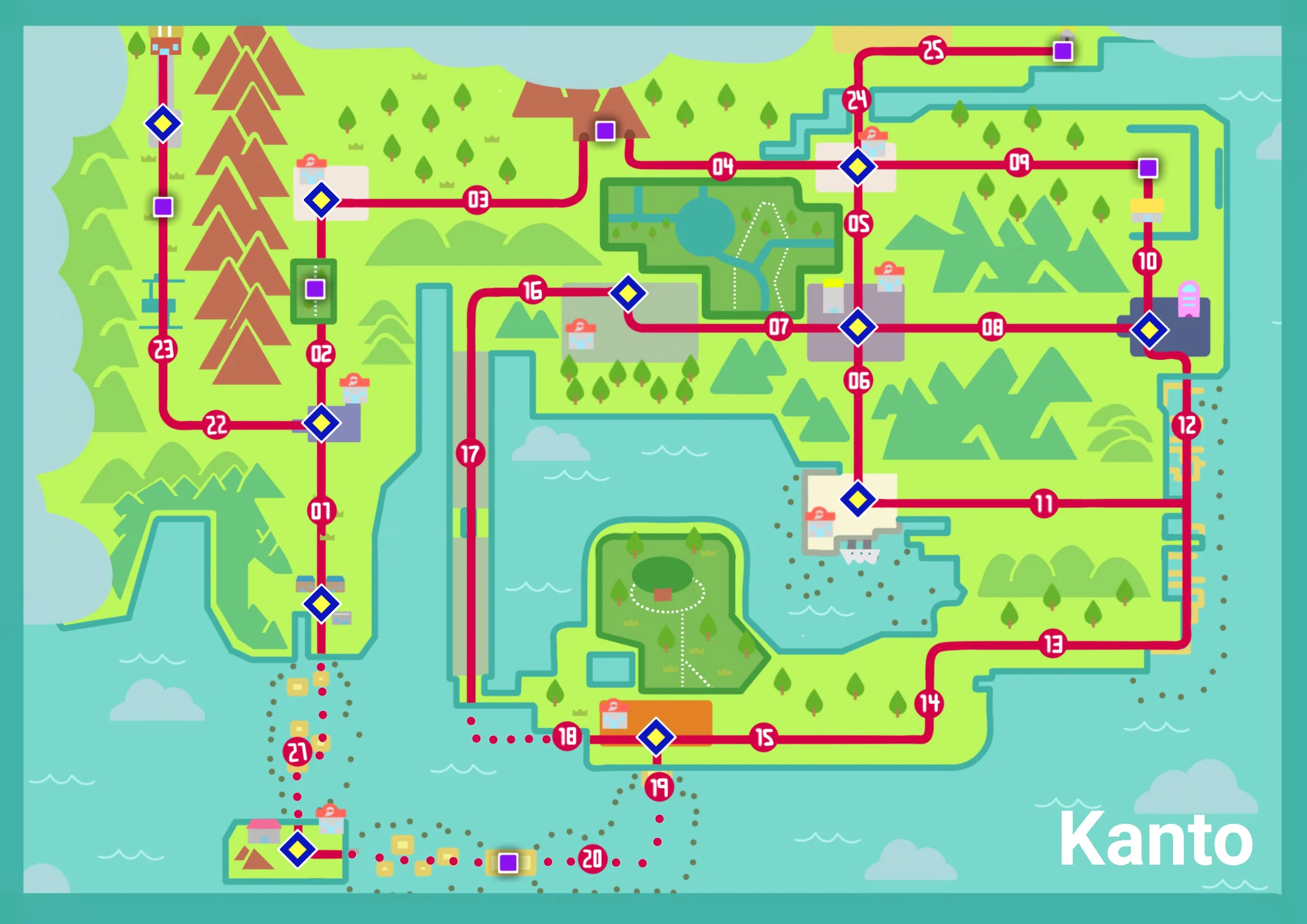 Kanto map.
The same philosophy applies to a greater or lesser extent to the rest of the regions. Every starter trio follows the same guidelines that force you to seek alternatives (or not), favoring exploration or, if the player opts for the quick route, giving greater linearity to the title.
After the first significant decision, a battle against our rival follows. In a safe environment, all the mechanics that circumnavigate the main system of the game are shown. It is usually a damage race, but the design team’s goal was to give the importance deserved to status moves, that is, those that modify stats. The player may also learn that it is not safe to hit an attack since Tackle has 95% accuracy (making Charmander the safest choice for this battle).
Overcoming the challenge implies leveling up, which will show that with each battle, our team strengthens; and defeat will make it clear that, unlike other contemporaries of the genre, you do not return to the last save point but go to a safe zone where all completed progress remains.
After our first encounter, another usual trope of the saga follows: an errand. This forces the player to go to a nearby area and understand how tall grass and wild Pokémon work, it will show that there are items in the world in the form of Poké Balls, train them through dialogue with NPCs (very relevant in this particular title), and show a miniaturized version of the region with its own idiosyncrasy (the infamous one-way walls, houses, areas blocked by bushes, rocks, or water, etc.).
In this first mission, if it can be called that, the player will practice the recent mechanic and awaken their interest in the different creatures there are. Some later titles place the first battle against the rival after (or during) this errand to give the player a level advantage, as happens in Johto or Hoenn.
Collecting is innate in humans, and Pokémon relies heavily on this drive to function. Therefore, the next logical step is to teach that any creature seen can be captured. The player will be given some Poké Balls, and this is where the tutorial ends, at least the actively guided part.
Pokémon Red and Blue, unlike any other title, leave you alone after ten minutes of gameplay. The rest of the lessons exploring the depths of the game (like evolution, hidden machines, the type chart,…) are relegated to friendly inhabitants who will explain them only if you wish. From the moment you receive the Pokédex, you are free to see the confines of Kanto.
Logically, the game still guides you, but the player does not notice it. The first two gyms, the real tutorial of the game, are linear areas. There are no detours, and the biggest obstacle, possibly, is the lack of orientation in Viridian Forest and Mt. Moon, which is used to favor the player by making them train for the gyms.
Once the real tutorial is over, the curiosity I mentioned needs to be fed. By the time the second badge is obtained, several mysteries invite discovery. In Viridian City, there are two: who is the gym leader and what is the Pokémon League. In Mt. Moon, there is a fossil and a violent gang of suspicious appearance. Finally, in Cerulean City, there is an inaccessible cave, a bicycle that is impossible to obtain, and a move that works outside of combat. Not to mention the two dozen creatures that will have already been registered.
The main mechanics have already been shown: effective moves, evolutions, battles, wild Pokémon, the different ways to obtain them, and the hidden moves. The game evaluates that you are ready to live an adventure without hand-holding, so it opens its world.
This distinction could give rise to an essay, but for me, open worlds did not start with Breath of the Wild or GTA. These are what I call free worlds, where you can do whatever you want whenever you please. There is no greater obstacle than your own means to reach any location on the map. You are free to do whatever you like. In contrast, open worlds have existed since the NES. The game guides you, but it does not limit you to a path. It is a world that progresses and evolves with gameplay. Pokémon Scarlet is a free world, and Pokémon Red is an open world, the only one in the entire franchise.
Celadon City branches out into multiple exits that embody the title’s purpose: a focus on adventure. Discovering where a path leads, what lies in the depths of a cave, or how to access the Bike Path. The player can chart their own course, and the order of the gyms is ultimately defined by the player’s choices. Erika may be a much more enjoyable destination for a trainer who chose Charmander, as its starter is useful for the first time. The Squirtle player will opt to explore how to traverse water and may reach the seventh gym, where they have an advantage. The Bulbasaur owner will have to seek alternatives against Sabrina, as their creature, unbeatable until now, has encountered the toughest wall to overcome.
Like a metroidvania, the central area of Kanto feeds off each discovery, providing a form of reward for exploring its world. If the player acquired the bike, by engaging with the Fan Club in Cerulean City, they can obtain a second tool for faster travel: Fly, which is hidden in a dialogue in the Bike Path. Entering the Safari Zone grants access to the best Pokémon in the game (Dratini), but also provides the Gold Teeth needed to obtain Surf and, subsequently, Strength, opening up the exploration of caves and seas, rewarded with the three legendary birds. As seen, the name Hidden Machine was only aptly applied in the first generation, as all these moves stem from a prior interest in the world that results in an expansion of it as a reward for discovering them.
It is this constant cycle of exploration-reward that gives Pokémon Red and Blue such value. It perfectly conveys the feeling of adventure, and I doubt I was the only one among those initial fifty million players still seeking that thrill in current titles.
Pokémon Red and Blue (or Green, to be more precise) have a context that no other title in the series possesses. Their development period was five years long, and they did not need to sell merchandise or attract a young audience with their design. This allowed for bolder design decisions that time has since buried. I feel an abstract mix of sadness and joy seeing that the series has shifted to open worlds rather than correcting itself and exploring new intentions with an open world that it mastered almost thirty years ago.
Context
One of the articles written for the Retro section of GamesTribune Magazine.