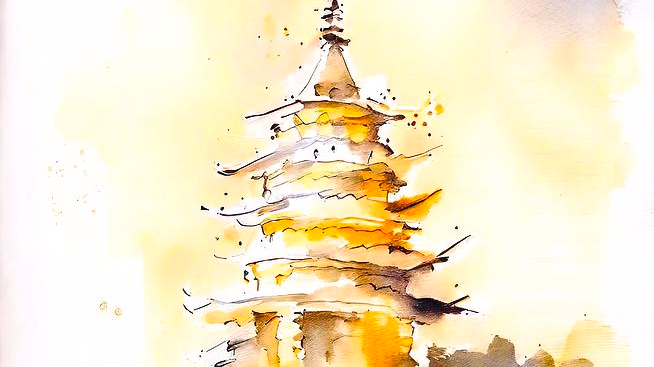
Ozoku Pagoda Environment Sheet
Visual aspect
Unlike most of the japanese emperors, the Child-Emperor’s Regent decided to move the nobility to one of the highest pagodas in Japan. After this, he ordered to paint it yellow, the colour of wisdom and notoriety. In addition, this colour represents the leadership. The building is inside an enormous garden with some ponds and not-too-high nature. There are only cherry trees showing the main entrance way.
Above its eight floors, on the roof, there is a blue sorin that tries to represent the link with the sky and, therefore, with the gods.
Inside, the pagoda is divided into small wooden rooms with tatami floor and sliding doors, but on the highest floor, where the Emperor and his Regent live, the doors are a lot more massive and sturdy and they are closed with a horizontal wooden beam. In the center of this room there is a central seat with a lot of colour and ornaments. This is the Regent’s place, meanwhile, the Kid-Emperor’s seat is a lot less decorated and more discreet.
Gameplay
The scenery is not really that important because it’s only the background while the different samurais and ronins are dueling with cards. However, the opening rounds, where the majority of participants are eliminated and then they can do a tournament tableau, are done in the imperial garden. Several tables are arranged and a referee is controlling different duels at the same time.
Once you pass these rounds, the following ones are done inside the pagoda. The fewer rounds remaining until the final, higher will be the floor where they play. This is done until the final, where it’s played in the Emperor’s room.
The Regent himself will supervise the final, while the highest nobility and militar chiefs will see it. After the duel, the champion will be named the Kid-Emperor’s right-hand and his samurai. Then, the winner must swear the votes.
Story
The Ozoku pagoda was one of the many rewards that the Kid-Emperor’s grandfather gained because of the wars he provoked. After obtaining it, he decided to rebuild it so it could be in perfect conditions and to use it as an exchange tool for following wars or as a present for some nobles.
After Heiwa’s death, he decided to sell the pagoda to one of the richest persons in Japan and use the money to boost the Uso cards reform. That rich man turned out to be the Kid-Emperor’s Regent, so as soon as he got close to the Emperor, he moved there.
In this way, he can show his power, enclosing the Emperor in his own house and with new colours that would express to everyone his magnificence and his cunning.
On the other hand, he held the Uso tournament in his own palace to control who was promoted and who was not. By refereeing the final duel, he could always know what type of person was going to spend more time with the Kid-Emperor and see if it was worthy.
Relevant items and characters
The characters that Tegami can see in the tournament are very diverse. From a broken ronin that he almost can’t buy a deck (or even he stole it) to high-ranked people of the army that want to have their name in the history.
The Regent will also be seen during the first rounds of the tournament and will be available for interaction.
On the other hand, there will be some items like pictures, vases or figures of the gods that will let us know the story behind the pagoda and what the Regent wanted and did with it. We can also get cards in two different ways. The first one is passing each round. Every time you beat an opponent, he must give you 3 random cards from his deck. The second way is in the shops in the pagoda gardens when you can buy and sell some cards.
Context
This text was an exercise for my Gametopia Narrative course, where I had to create a scenario sheet. In this case, the game I used was a fictional one created at the start of the course, set in feudal Japan where weapons were banned, and conflicts had to be resolved with cards.