Kyodia Weapon Sheet
Visual aspect
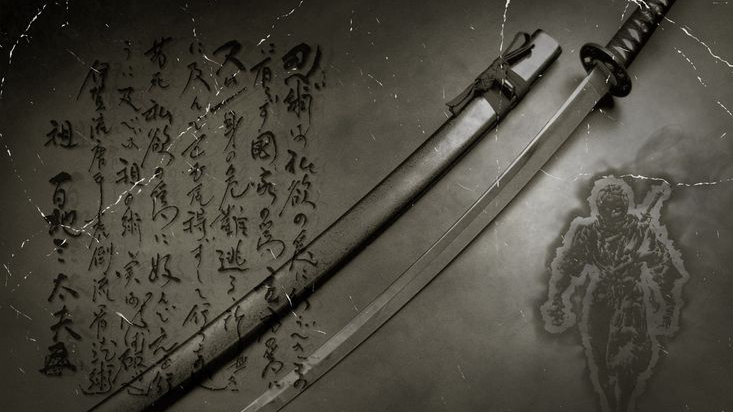
It is a pretty small katana made for little kids so they can learn. It has a sharp edge and it is slightly angled backwards at the end. The blade is not rusty, but it does have some cuts on the side parts because of the many fights that Tegami had.
The sheath, on the other hand, is spotless. It doesn’t have any scratches at all, except for the hole where the katana is inserted, which has many of them. It is entirely black and it doesn’t have any kind of ornament or strap. The katana doesn’t have cloth on the handle either.
Story
The Kyodai katana was the only thing that Meshia left to his son Tegami when he tried to protect him, killing the Emperor’s daughter. Throughout his life, Tegami used this katana a lot, in order to train or survive, so he has been gradually convincing himself that giving him the katana was the only thing that his father did for him. This is the reason why he called it Kyodai.
In the Kid-Emperor’s Uso tournament, he will have to hide it well so the soldiers can’t take it or arrest him, that’s why he keeps it under his kimono.
Penalties and limits
Due to the Katana’s prohibition, anyone will be arrested as soon as he is discovered with one, and he will have to face a trial. Before this, the katana will be melted down and its steel will be reused.
Therefore, throughout the Uso’s tournament, Tegami will only have one chance to use Kyodai. When the player speaks with the rest of the participants, he will have the chance of killing them, but this is Game Over so it’s not recommended.
Tegami’s desire is that the last sword to hit Kyodai will be the one needed to repeal the Katana’s prohibition law, believing Tegami that this hit is for the Kid-Emperor. However, it is in the hands of the player, who, through the story, will choose the use of the katana.
Context
This text was an exercise for my Gametopia Narrative course, where I had to create a weapon sheet. In this case, the game I used was a fictional one created at the start of the course, set in feudal Japan where weapons were banned, and conflicts had to be resolved with cards.